

A quality-management certificate can support supplier evaluation, but it does not prove that every powder coating batch is suitable for every application. Industrial buyers need a product-specific control plan: agreed inputs, traceable manufacturing records, representative test panels, defined methods, acceptance limits and a clear response when results fall outside the specification. This guide explains what to ask a powder coating manufacturer before approving a source or repeat order.
Start with the purchaser specification
Quality control cannot be separated from the requirement being controlled. The buyer should identify the substrate, pretreatment, exposure, coating chemistry, color or physical reference, gloss and texture, film build, cure window, application equipment, reclaim policy and required tests. The China powder coating manufacturer guide provides a sourcing overview, while the supplier qualification checklist covers the broader commercial audit. ASTM D3451 states that test selection and interpretation depend on the individual case and agreement between purchaser and seller. A generic pass statement is therefore weaker than a record tied to the approved specification.
Separate the quality system from product approval
ISO 9001 defines requirements for a quality management system. Certification evaluates the organization and its processes; it is not blanket certification of each formulation or batch. Ask for the certificate scope, issuing certification body, covered site and validity, then separately define product evidence. A useful review connects purchasing controls, approved formulations, production instructions, inspection records, nonconforming-material handling, complaint investigation and change control to the exact product being purchased. DAMEI's management-system certificates can be reviewed on the About DAMEI page, but the buyer must still approve the coating and evidence for the project.
Control incoming materials and the approved formulation
Powder coating manufacture combines resins, curing agents, pigments, fillers and additives whose identity and variation can affect processing and appearance. The manufacturer should be able to identify approved raw-material specifications, lot references and the authorized formulation revision without disclosing proprietary formula percentages. Substitutions or source changes should follow documented review rather than informal replacement. The relevant evidence is not a promise that variation is impossible; it is a traceable record showing what was used, what revision applied and how the finished batch was checked.
Record critical manufacturing stages
Batch records should connect the material lots to weighing, premixing, extrusion, cooling, grinding, classification, final blending and packaging. The exact parameters are formulation- and equipment-specific, so buyers should not impose universal values copied from another product. Instead, ask which parameters are controlled, who authorizes deviations and how contamination or line-clearance risks are managed. The Powder Coating Institute notes that consistent manufacture depends on incoming-material and process control, while late adjustment of a powder batch can be difficult.
Check powder properties that matter to the application
A test plan may include particle-size distribution, density, flow behavior, gel time or inclined flow, but no single list is correct for every powder. ISO 8130-1 describes sieve analysis and notes its use as a quality-control check for oversize material or contamination. ISO 8130-13 covers laser-diffraction particle-size analysis, while ISO 8130-5 addresses powder/air flow behavior. ASTM D3451 warns that some powder-characterization results are comparative rather than universal good-or-bad values. The purchaser and manufacturer should therefore agree on the method, specimen, conditioning, units and limit before using a result for acceptance.
Use a representative cured panel
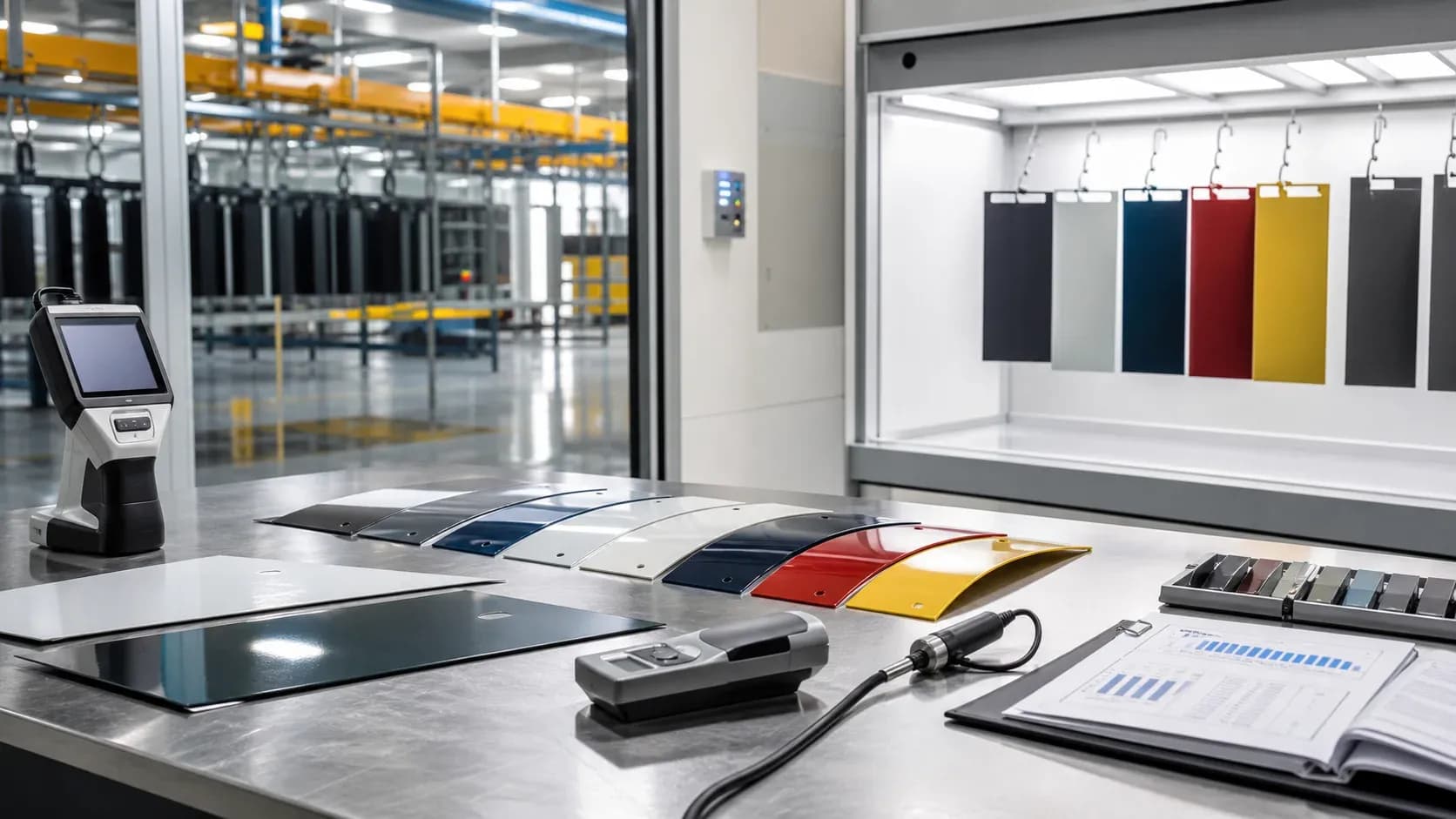
Powder-only measurements do not prove the final finish. Apply the batch to a defined panel using recorded film thickness and a cure schedule tied to actual metal temperature. Compare appearance, color, gloss, texture and relevant film properties against the approved reference. TIGER Coatings advises an acceptance trial on the actual application equipment because equipment, application variables and reclaim can change the visible result. For production planning, review the cure schedule guide, film-thickness guide and quality-control test guide.
Define color, gloss and film tests precisely
A color statement should identify the physical or instrumental reference, illumination and observation conditions, geometry, formula and tolerance agreed by both parties. ASTM D2244 requires purchaser and seller agreement on the permissible color tolerance and calculation procedure. ASTM D523 covers specular-gloss measurement but does not replace assessment of texture, haze or distinctness of image. Adhesion, impact, corrosion or weathering tests likewise need the exact method, substrate, pretreatment, film build, cure, duration and rating criterion. Do not accept an isolated number without the test context needed to interpret it.
Require batch identity and usable shipment documents
The package label, batch number, manufacture record and shipment documents should resolve to the same product identity. Depending on the order, a buyer may request the current TDS, SDS, certificate of analysis, color reference, retained-panel identifier, packaging information or specific test report. Availability and fields should be agreed during quotation. A COA is useful only when it reports the characteristics and methods relevant to the approved requirement; it is not a substitute for the purchaser's own receiving and production controls.
Verify consistency on the buyer's coating line
Laboratory results are an input to qualification, does not by itself establish line performance. Before normal production, run a representative trial using the buyer's substrate, pretreatment, grounding, guns, reclaim practice, film build and metal-temperature profile. Record the approved settings and finished-part results. For repeat orders, compare the new batch against the retained standard under the same agreed conditions. When appearance is sensitive, avoid combining unverified batches on one visible assembly until the buyer has confirmed the match.
Agree on deviations, changes and complaint evidence
The purchasing specification should state who is notified when a raw material, formula, process, site or test method changes. It should also define quarantine, investigation and disposition for a nonconforming result. A useful complaint file includes product and batch identity, storage history, application settings, reclaim ratio, film thickness, cure profile, photographs, affected quantity and representative samples. This evidence helps separate powder manufacture, storage, application, pretreatment and cure causes without assuming the supplier or coater is responsible before the data is reviewed.
Build a manufacturer approval record
A defensible approval pack combines the supplier audit, specification, approved panel, trial record, agreed test plan, document list, batch traceability and change-notification terms. Buyers sourcing from DAMEI can send these requirements through the technical review and quotation form. DAMEI can confirm what can be supplied for the selected formulation and prepare a sample plan; final approval remains with the purchaser after representative testing.
References
- ASTM D3451-24: Standard Guide for Testing Coating Powders and Powder Coatings
- ISO 9001 explained
- ISO 8130-1:2019: Particle-size distribution by sieving
- ISO 8130-13:2019: Particle-size analysis by laser diffraction
- ISO 8130-5:2021: Flow properties of a powder/air mixture
- ASTM D2244-22: Calculation of color tolerances and color differences
- ASTM D523-25: Specular gloss
- TIGER Coatings: Batch-to-batch consistency