
Changing powder coating suppliers is a controlled technical change, not a same-color purchasing substitution. Two powders with similar names or appearance can differ in chemistry, cure response, particle behavior, application window and compatibility with residual material. A safe transition defines the current reference, compares documents, tests representative panels, cleans and trials the actual line, and records purchaser approval before routine production.
State why the supplier change is being considered
Record the business and technical objective without turning it into a predetermined product conclusion. The trigger may be availability, documentation, color matching, application behavior, support, destination requirements or a need for an alternate source. Identify which characteristics of the current powder must be maintained and which may be changed. Use the supplier qualification checklist for the organizational review. If the current reference is an AkzoNobel/Interpon product, use the Interpon alternative sourcing guide; DAMEI does not sell Interpon, and a candidate must not be described as identical or drop-in equivalent without project-specific evidence and purchaser approval.
Freeze the current reference before comparing candidates
Collect the current product name and code, latest TDS and SDS, batch identity, approved panel, substrate, pretreatment, film build, cure profile, application settings, reclaim practice, test reports and recent production observations. Note which items are contractual requirements and which are only historical settings. A color code alone is not enough. Without a controlled baseline, a trial cannot show whether a difference comes from the candidate powder, the line, the substrate or an undocumented change in the existing process.
Compare product data without assuming equivalence
Review chemistry family, intended use, exposure limits, color and finish, density basis, application guidance, storage guidance, cure schedule and relevant approvals or test evidence. Confirm that both documents use comparable test methods and units before comparing values. ASTM D3451 says test selection and interpretation depend on the individual case and purchaser-seller agreement. A candidate can meet the buyer's requirement without duplicating every proprietary characteristic of the previous product, but that decision must be written into the new specification.
Treat powder mixing as a separate risk
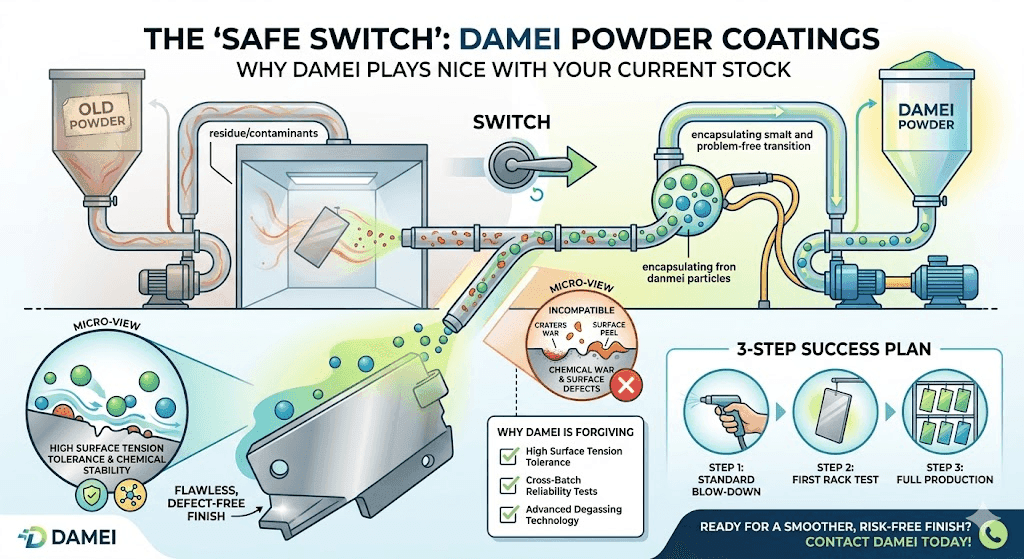
Do not assume two thermoset powders are compatible because they share a generic chemistry or color. ISO 8130-12 specifies a visual method for evaluating surface deterioration caused by mixing different coating powders and explains that incompatibility depends on reactivity, composition, melt properties and mixing ratio. The method helps predict appearance problems; it does not authorize uncontrolled mixing on a production line. Keep candidate and incumbent powders, recovery material and containers identified and separated until the transition plan is approved.
Plan line clearance and contamination control
Define how hoppers, pumps, hoses, guns, booth surfaces, cyclone or filters, sieves, reclaim loops and containers will be cleaned or isolated. The necessary procedure depends on the equipment, finish sensitivity and powders involved. Record the last incumbent batch, cleaning completion, first candidate batch and disposition of transition powder. Do not return unidentified material to stock. For a sensitive color or effect, consider a controlled virgin-powder trial before introducing reclaim so the base comparison remains interpretable.
Match color, gloss and texture to an agreed standard
Compare the candidate against the approved physical standard under agreed lighting and measurement conditions. If instrumental color is used, ASTM D2244 requires agreement on the tolerance and calculation procedure; different color-difference systems cannot be treated as interchangeable. ASTM D523 covers specular-gloss measurement, while texture and effect appearance may require additional visual or multiangle evaluation. Review the color-difference guide and gloss guide before defining acceptance.
Verify application and cure on representative parts
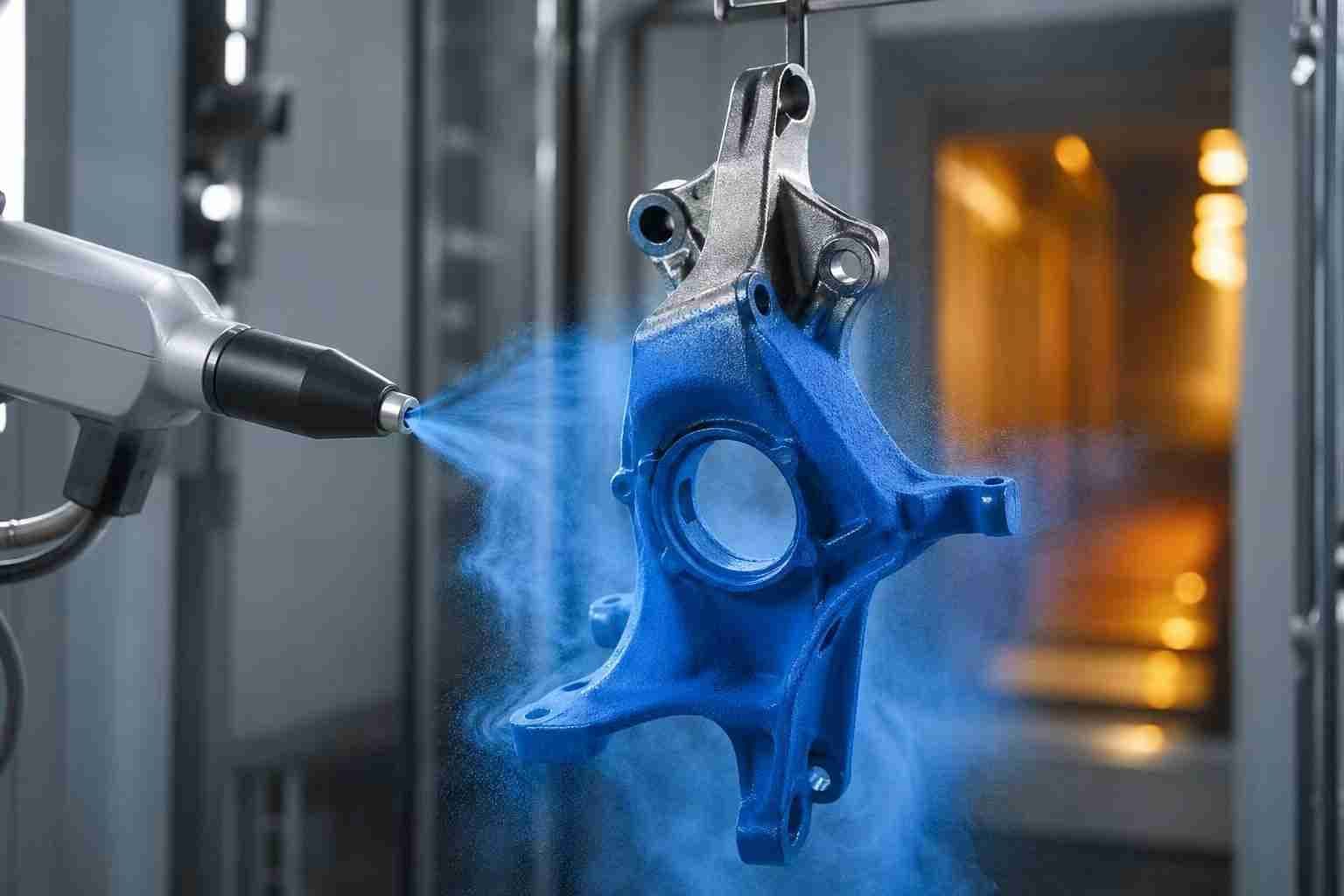
Apply the candidate with the intended guns, charging mode, grounding, line speed, film build and part geometry. Record actual metal temperature rather than relying only on oven air settings. TIGER Coatings advises an acceptance test on the actual application equipment because equipment and reclaim variables influence the final color or effect. Check first-pass application behavior, difficult geometries, appearance and the cure-dependent properties required by the specification. Use the application best-practices guide and cure schedule guide to structure the trial.
Repeat only the tests needed for the changed system
Select qualification tests from the substrate, pretreatment, exposure, coating system and purchaser requirement. A supplier change may require color, gloss, film thickness, cure and adhesion checks; critical projects may add mechanical, corrosion, humidity, weathering or chemical tests under named methods. Do not copy a salt-spray duration or pass criterion from unrelated marketing material. The powder coating quality-control test guide explains how to document method, specimen, conditioning, evaluation and acceptance.
Review reclaim and adjacent-batch strategy
If production uses reclaim, qualify the intended candidate reclaim process and its effect on appearance and application. Do not blend incumbent reclaim into candidate powder unless compatibility and the written process specifically allow it. For visible assemblies, continuing projects or repair work, define how incumbent and candidate batches will be segregated and compared. A successful flat panel does not automatically prove that adjacent production parts will look the same across geometry, film build and application conditions.
Confirm documents, identity and traceability
Before approval, confirm the candidate product code, specification revision, manufacturer and site, batch identification, packaging, storage guidance and required TDS, SDS, COA or test reports. Document availability must be agreed for the exact product and destination. A management-system certificate supports supplier evaluation but does not certify the formulation. The purchase order should reference the approved candidate, panel, trial record and notification requirements so later orders do not revert to an ambiguous verbal match.
Approve the transition with limits and a fallback plan
The approval record should state the parts, substrate, pretreatment, line, color/finish, film build, cure window, test methods, acceptance criteria, reclaim rules and effective date. Identify who can authorize deviations and what evidence triggers quarantine or requalification. Plan the disposition of incumbent stock, candidate trial material and transition parts. Where continuity matters, preserve an approved reference and enough traceability to investigate a later difference without guessing which powder or process was used.
Request an alternative-source review
Send DAMEI the current product code and TDS, a coated reference, substrate and pretreatment, service exposure, coating-line and cure data, finish controls, required tests, estimated volume and destination through the technical review form. DAMEI can assess whether a candidate formulation and sample plan can be proposed. The buyer remains responsible for comparing the evidence and approving the candidate on representative production parts.
References
- ISO 8130-12:2019: Determination of coating-powder compatibility
- ASTM D3451-24: Standard Guide for Testing Coating Powders and Powder Coatings
- ASTM D2244-22: Calculation of color tolerances and color differences
- ASTM D523-25: Specular gloss
- TIGER Coatings: Batch-to-batch consistency and application-equipment acceptance trials
- ISO 9001 explained