Shipping Container Powder Coating Starts With the Service Environment
A shipping container coating specification should begin with the container's actual future use, not with a generic promise about one powder chemistry. A new cargo container, a retired container converted into a building, and fabricated container-house panels can have different substrates, old coatings, weld conditions, exposure zones, and regulatory obligations.
ISO 1496-1 covers specifications and testing for general-purpose freight containers, while ISO 12944-2 classifies corrosive environments for steel structures. Neither reference turns one coating recipe into a universal answer. The purchaser, fabricator, pretreatment supplier, powder manufacturer, and applicator should agree on the service environment and acceptance plan before production.
For a purpose-made container house, review DAMEI's container-house powder coating as a product starting point, then qualify the exact color and system on representative production metal.
Inspect the Container Before Choosing a Coating System
The first decision is whether the project uses new fabricated steel panels or a previously used freight container. A used unit may carry unknown cargo residues, labels, repair materials, corrosion products, sealants, and several generations of liquid paint. Cutting, welding, grinding, or heat straightening can create further local differences.
Record at least:
- substrate and fabrication records available from the supplier;
- intended indoor, outdoor, coastal, industrial, or sheltered exposure;
- existing coating condition and any unknown repair areas;
- corrosion at seams, folds, corner fittings, roof edges, and floor interfaces;
- weld spatter, sharp edges, burrs, adhesive residue, oil, and soluble contamination;
- parts that cannot tolerate the selected oven profile;
- drainage, water traps, dissimilar-metal contacts, and inaccessible crevices;
- whether structural modification requires separate engineering or regulatory approval.
Do not infer the exact steel grade or previous paint system from appearance alone. Where identity affects the process, confirm it from records or testing.
Define Corrosion Exposure and Acceptance Criteria
ISO 12944-2 is useful for describing the environment, but the final coating system still needs project-specific requirements. The specification should identify the substrate, preparation method, pretreatment, primer or topcoat arrangement, target film thickness range, color and gloss, cure schedule, inspection methods, sampling frequency, repair method, and acceptance authority.
Neutral salt spray can support comparison and qualification, but it is not a direct prediction of outdoor life. ASTM B117 defines the salt-fog apparatus and operating conditions; it does not prescribe a universal exposure period or interpretation for every product. State the specimen construction, scribe method, edge treatment, exposure duration, and evaluation criteria in the purchase specification.
Use the same discipline for adhesion, impact, flexibility, humidity, weathering, and color change. ASTM D3451 emphasizes that test selection and interpretation depend on the individual application and agreement between purchaser and seller. DAMEI's quality-control test guide can help organize the qualification plan.
Remove Contamination and Prepare the Steel
Coating performance depends on a clean, stable substrate. The required preparation cannot be selected safely from an article alone because a new panel, intact compatible coating, and heavily repaired used container may require different work.
A controlled preparation sequence normally includes:
- identify and safely remove cargo residue, oil, adhesive, sealant, and other contaminants;
- repair fabrication defects and round or dress edges where the project specification requires it;
- remove loose corrosion and incompatible coating to the agreed preparation grade;
- measure surface profile when abrasive blasting is specified;
- assess water-soluble contamination before coating;
- apply and control the selected chemical pretreatment or primer system;
- dry the work without leaving moisture in seams or recesses;
- protect the prepared surface from recontamination before powder application.
ISO 8501-1 provides visual preparation grades for steel surfaces. ISO 8502-6 describes extraction of water-soluble contaminants, and ISO 8502-9 describes conductometric assessment. Those methods do not supply one universal salt limit; the project owner and coating-system supplier must set the acceptance value.
For chemical preparation choices, see the powder coating pretreatment guide.
Select Primer and Topcoat as a Complete System
Exterior polyester powder may be appropriate for many outdoor decorative applications, while epoxy powders are commonly evaluated for protected primer or functional use. Chemistry names alone do not establish suitability for a converted container. The complete system must be compatible with the substrate, pretreatment, film build, cure window, exposure, color, repair process, and required tests.
A project may evaluate a single-coat system or a qualified primer-and-topcoat system. When two coats are considered, confirm intercoat timing, grounding, edge coverage, total film thickness, and whether both layers achieve their specified cure. A zinc-containing primer should not be selected only from the word “zinc”; its formulation, substrate preparation, film build, topcoat compatibility, and test evidence all matter.
Use the corrosion-resistant powder coating guide to prepare the technical questions, then request the current product data sheet and a project-specific recommendation.
Design for Edges, Welds, Corrugations, and Water Traps
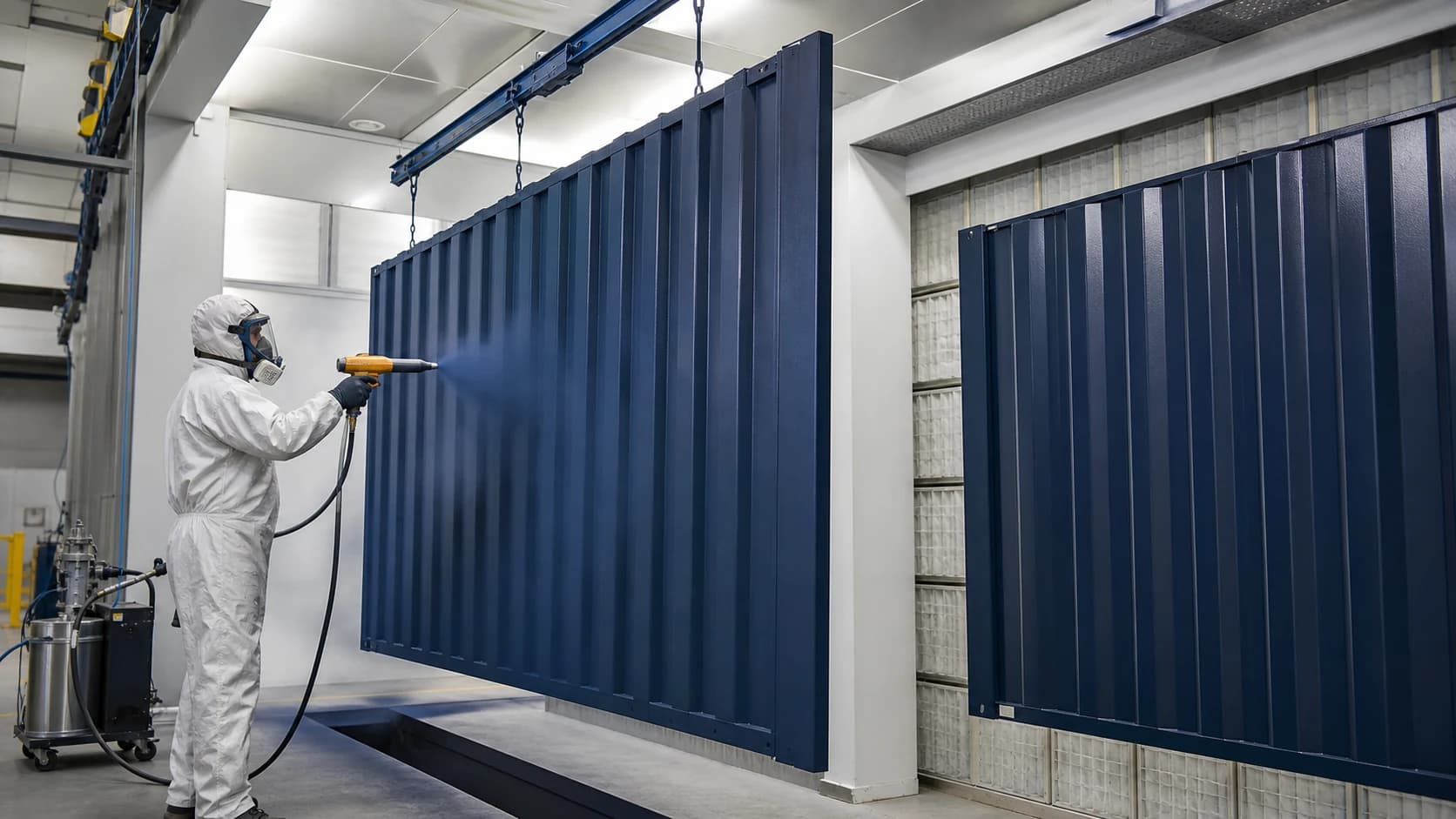
Corrugated panels, box sections, corner fittings, seams, and deep recesses can receive less powder than broad flat surfaces. High electric field strength can also make deposition in recessed geometry more difficult. The applicator should establish gun distance, voltage or current limits, flow, part orientation, manual reinforcement, and line speed on representative geometry rather than copy a universal setting.
Sharp edges and rough welds can produce thin or discontinuous coverage. Fabrication quality, edge preparation, hanging, grounding, booth cleanliness, and accessible gun paths are therefore part of corrosion control. Measure cured film at both easy and difficult locations under an agreed sampling plan; an average reading on the center of a flat panel cannot prove adequate edge coverage.
See the film-thickness guide and application best practices for line-control details.
Verify the Actual Cure on the Container or Representative Parts
The cure schedule in a powder data sheet refers to the workpiece metal temperature and time within the specified window, not merely the oven-air setpoint. Large assemblies, light corrugated sheets, corner castings, and added frames can heat at different rates. An oven profile should follow the slowest relevant area without overexposing the fastest area beyond the approved window.
Record the profile with probes placed on representative cold and hot locations. Confirm that the chosen powder, primer, pretreatment, sealants, and any heat-sensitive components are compatible with the complete cycle. The powder coating cure-schedule guide explains the difference between oven setting, metal temperature, bring-up time, and cure dwell.
If the complete container cannot fit the coating line or oven, specify a panelized fabrication and coating sequence or a different approved coating method. Do not promise powder coating for an assembly that the applicator cannot prepare, spray, heat, inspect, and repair consistently.
Build a Recorded Qualification and Production Control Plan
Use representative production metal with the intended fabrication, pretreatment, powder batch, film build, cure profile, and edge condition. A flat laboratory panel can help compare materials, but it may not represent corrugations, welds, seams, or thermal mass.
The qualification record should include:
- substrate and pretreatment identification;
- powder product and batch traceability;
- application settings and environmental conditions;
- film-thickness readings by location;
- logged metal-temperature profile;
- appearance, color, gloss, adhesion, and other agreed tests;
- corrosion-test specimen design and evaluation method when required;
- repair materials, repair boundaries, and retest rules;
- approver names and the accepted deviation process.
For salt-fog planning, use DAMEI's salt-spray test guide together with the current purchased standard and the customer's acceptance specification.
Plan Damage Repair and Maintenance Before Delivery
Transport, lifting, assembly, window installation, and site work can damage the coating after factory inspection. Agree in advance how exposed metal, scratches, weld repairs, and field-cut edges will be cleaned, repaired, blended, documented, and accepted. A liquid repair material may be practical for local site damage, but its color, gloss, compatibility, thickness, and durability should be qualified for the intended exposure.
Provide the owner with inspection points and a maintenance plan focused on damaged coating, retained water, seal failures, roof and edge details, fasteners, and interfaces with other materials. No coating can correct a design that continuously traps moisture or leaves bare cut edges.
Information to Send With a Container-Coating RFQ
For a technically useful recommendation, send:
- new fabricated panels or used-container conversion;
- substrate records and existing coating information;
- drawings, dimensions, welds, corrugations, and difficult recesses;
- service location and corrosion exposure;
- indoor or outdoor use, color, gloss, and appearance standard;
- pretreatment and oven capability;
- required film-thickness range and test standards;
- representative part mass and line speed;
- packaging, transport, installation, and field-repair expectations;
- required certificates, sample quantity, and approval authority.
DAMEI manufactures powder coating material; the local applicator performs the coating process. Contact DAMEI to discuss a container-house powder specification and representative sample plan. Final acceptance remains tied to the agreed product data, prepared production metal, recorded process, and project tests.