
On September 2, 2026, AkzoNobel announced the opening of a €7.5 million powder coatings innovation laboratory in Sassenheim, the Netherlands. Its stated priorities include lower-temperature curing technology and solutions that help customers improve productivity. The investment brings renewed attention to an operational question for powder buyers: can a different cure schedule improve this particular production line? Read AkzoNobel’s announcement.
Our reading of the news is that cure efficiency deserves a place in supplier discussions alongside coating performance, color and price. An R&D announcement identifies a development direction; the purchasing decision still needs evidence from the product and the line being evaluated.
A product transition makes the trend practical
A separate Interpon D2525 Anodic Low-E transition notice shows how low-cure technology affects existing projects. Effective September 1, 2026, selected older products changed from stock availability to made-to-order status as new Low-E codes entered the stock range. The notice describes curing at 150°C object temperature or using faster line speeds, subject to the applicable product schedule.
It also advises against mixing the older Anodic III and new Anodic Low-E products on one building. For buyers, the useful lesson is to confirm the precise product code, technical revision and approved appearance before a transition. A familiar color name alone does not settle procurement continuity.
Define the trial before requesting a price
A useful first conversation with a supplier starts with one measurable objective: a lower workpiece-temperature requirement, shorter dwell, increased accepted output, or reduced energy per accepted part. Agree which objective takes priority so purchasing, production and quality teams evaluate the same result.
Request a current TDS for the exact chemistry, color and finish. Ask how the proposed schedule will be demonstrated on representative parts. Record part-metal temperature rather than relying on oven-air setpoint, and check the slowest-heating areas of the load. DAMEI’s cure-schedule and part-metal guide explains this distinction.
Keep coating acceptance separate from the production target. Agree the required appearance and relevant performance tests before the trial, then retain the profile, powder batch and results.
Where DAMEI’s 130°C TDS fits
DAMEI publishes a 130°C low-temperature cure powder coating TDS for a specific epoxy-polyester hybrid in RAL 9016 high gloss. Its published cure guidance is 130°C for 15 minutes at peak metal temperature, subject to the complete TDS and line validation. That is a formulation-specific condition, not a universal schedule for every DAMEI powder, color or substrate.
It should not be treated as an alternative to Interpon’s architectural polyester range on temperature alone. Service environment, chemistry, durability requirements and project approvals must be reviewed independently. The lower numerical cure temperature does not establish exterior performance or suitability for MDF. Confirm the candidate formulation and current document revision with DAMEI before ordering samples.
Make any efficiency claim measurable
For a purchasing comparison, request a trial record that reports metered energy alongside accepted output, using the same measurement boundary and comparable production conditions. Include rejects and rework in the comparison. A temperature reduction by itself is insufficient to promise a saving percentage for another plant.
Send a project brief for a matched sample
Contact DAMEI with your substrate, pretreatment, part dimensions and mass, indoor or outdoor exposure, color and gloss, target film thickness, current oven profile, line speed, expected volume and destination market. State the trial objective and acceptance criteria. This gives our team a practical basis to review a candidate powder, confirm the documentation and propose a representative sample plan.
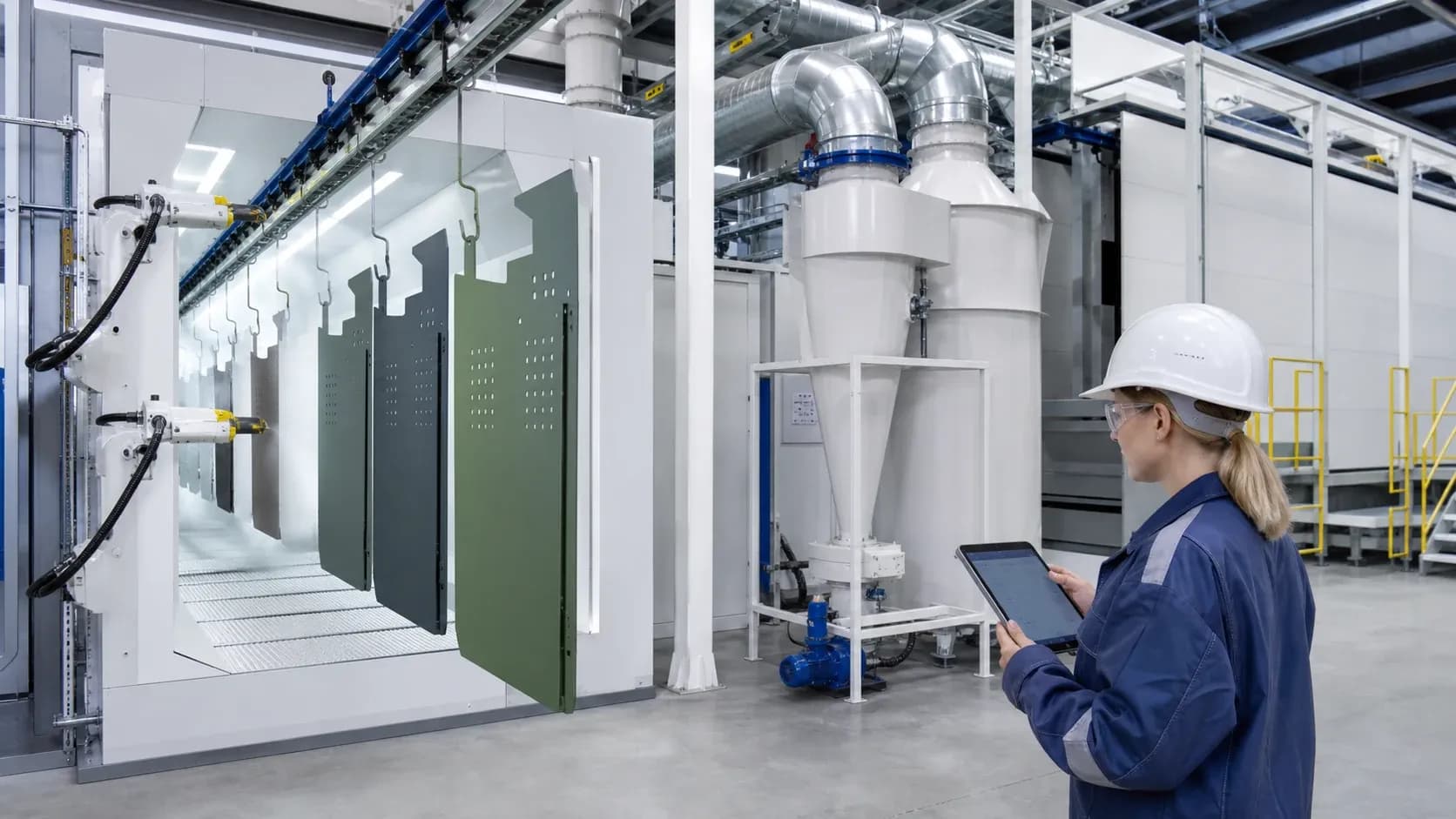
Cover illustration: industrial powder coating application.