
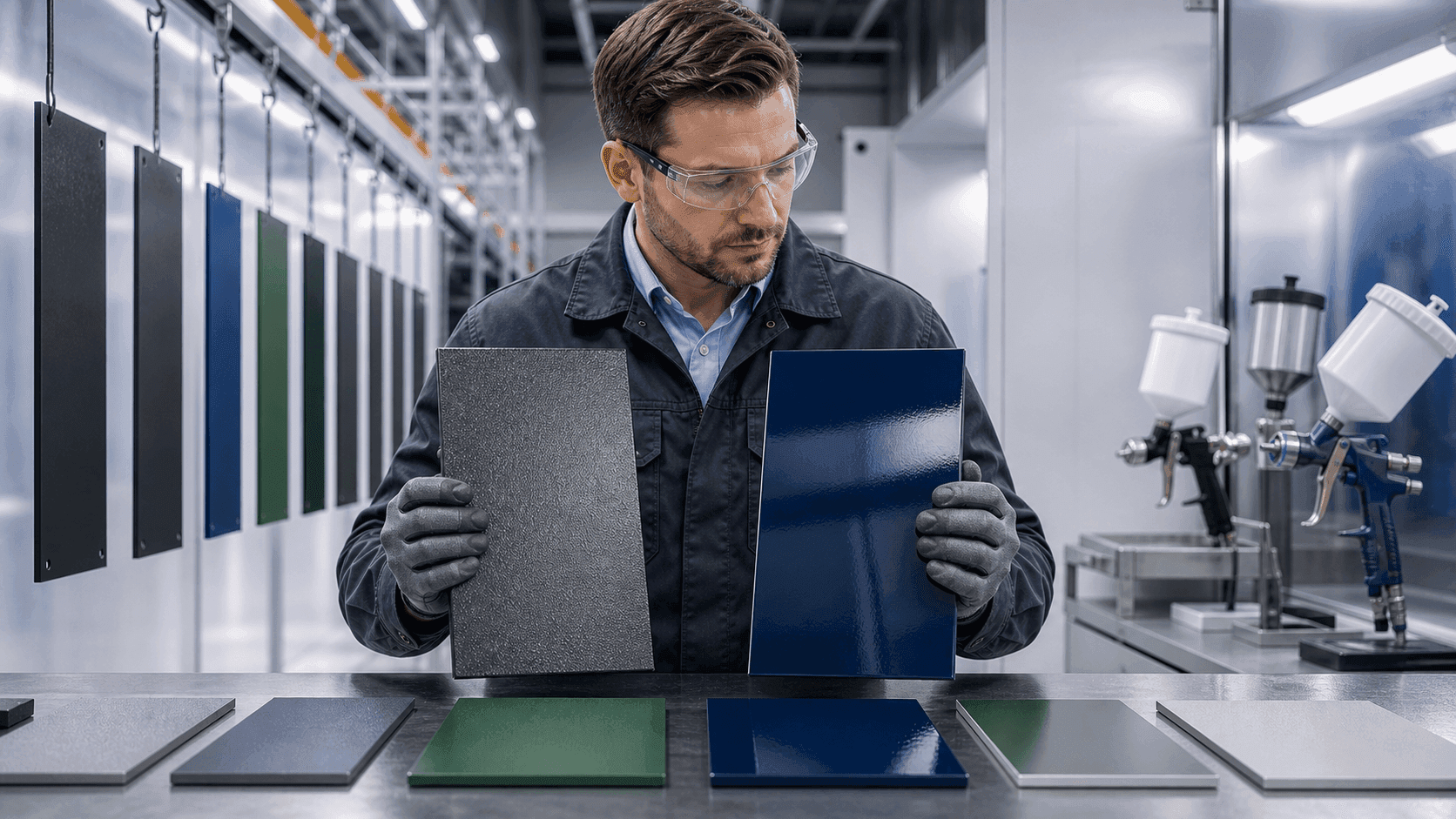
Powder coating and liquid paint are both established industrial finishing technologies. Neither is the automatic winner for every component. The right choice depends on substrate, geometry, production volume, appearance, service environment, available curing process, environmental controls and the customer's qualification plan.
A useful comparison starts with the finished part and the complete process, not with a single headline about material use or emissions. This guide gives manufacturing and sourcing teams a structured way to choose and document the coating route.
Quick comparison by decision factor
| Decision factor | Powder coating | Liquid paint |
|---|---|---|
| Material form | Dry coating powder applied electrostatically | Resin, pigment and additives carried in a liquid system |
| Film formation | Powder melts, flows and cures under the specified thermal process | Film forms through carrier release and, for some systems, chemical or thermal cure |
| Substrate fit | Common on conductive metal parts that tolerate the selected cure process | Broad formulation range, including systems for heat-sensitive or complex substrates |
| Geometry | Requires attention to grounding, recesses and Faraday-cage areas | Can suit some intricate shapes, with its own sag and overspray controls |
| Appearance | Wide range of colors, textures and gloss levels | Wide range of colors, gloss levels and special visual effects |
| Material recovery | Some booth systems collect overspray for controlled reuse when product and finish permit | Overspray handling depends on the paint and application system |
| Environmental controls | Usually avoids the liquid carrier used in conventional solvent-borne coating; dust, curing and local controls still apply | Requirements vary between water-borne, solvent-borne and other liquid technologies |
| Changeover | Depends on booth design, cleanliness standard and color sequence | Depends on delivery system, flushing, waste handling and color sequence |
The table is a screening tool. Final selection still needs coating-supplier data and trials on representative production parts.
Begin with substrate, geometry and heat tolerance
Powder coating is widely used on steel, galvanized steel and aluminum, but surface condition and pretreatment remain decisive. The part must also tolerate the product's required cure profile without distortion, assembly damage or unacceptable substrate change.
Liquid systems may be considered when the substrate or assembled component cannot accept the selected powder-cure process. They can also be useful where field application, very large structures or a specific approved system governs the choice. This does not remove the need to evaluate cleaning, pretreatment, ventilation, drying and curing.
Complex geometry affects both technologies. Deep recesses and shielded areas can be difficult for electrostatic powder deposition. Liquid paint may reach some areas differently, but can introduce runs, sags or uneven carrier release. Use representative parts and agreed inspection points to compare coverage rather than assuming one process handles every shape better.
Compare the required finish and performance system
Powder coating and liquid paint each describe families of chemistries, not one performance level. Polyester, epoxy, hybrid and other powder systems have different intended uses. Liquid technologies also vary by resin, carrier and cure mechanism. Compare a specific candidate against the service environment and customer specification.
Define color tolerance, gloss, texture, film range, edge coverage, adhesion, flexibility needs, chemical exposure, corrosion system and outdoor weathering requirement. State the test method, substrate, pretreatment, conditioning and acceptance limit. ASTM D3451-24 provides guidance on testing coating powders and powder coatings, but the project specification must define acceptance.
For thickness planning, see our powder coating film-thickness guide. For release testing, use the powder coating quality-control tests guide.
Evaluate environmental and safety controls without shortcuts
Powder coating generally does not rely on the liquid carrier found in conventional solvent-borne paint. That distinction can reduce certain solvent-management needs, but it does not make every powder line emission-free or remove safety obligations. Facilities still need suitable dust collection, housekeeping, grounding, fire and explosion controls, ventilation, personal protection, waste handling and review of curing emissions under applicable rules.
Liquid-paint requirements depend on the exact technology. Water-borne does not mean every constituent or control requirement disappears, and solvent-borne formulations differ in volatile content and regulatory treatment. Compare current safety data, product data, permits and local requirements for the real facility. The U.S. EPA surface-coating guide provides pollution-prevention context, while site-specific compliance decisions belong with qualified environmental and safety professionals.
Do not use a universal “green” label as the selection criterion. Request the documents needed for the jurisdiction, coating chemistry and line design, then verify how the full process will be controlled.
Compare the complete production process
Material price alone does not describe coating cost. Review pretreatment, racking, masking, labor, booth operation, color-change time, material recovery, waste, ventilation, curing, inspection, rework, maintenance and line utilization. The balance changes with part mix, batch size, finish requirements and existing equipment.
Powder overspray may be reclaimable in a compatible booth and controlled color campaign. Whether reclaim is appropriate depends on product, appearance standard and contamination plan. Liquid lines may have different transfer, flushing and waste characteristics. Model each proposed process using plant data instead of copying a generic utilization number.
Curing is another system decision. Powder requires evidence that representative parts reach the supplier's part-metal cure window. Some liquid systems dry at ambient conditions; others need thermal or chemical cure. Compare bottlenecks, part mass, oven profile, handling and inspection—not simply the nominal oven setting. Our powder coating cure-schedule guide explains this distinction.
Use a qualification matrix, not a brand shortcut
Build a matrix with each required attribute in one row and each candidate system in one column. Record the supplier document, sample result, test method, acceptance limit and open question. This creates a traceable basis for customer approval and later process control.
For companies comparing AkzoNobel Interpon powder with an independent Chinese powder coating manufacturer, require equivalent evidence from every candidate: chemistry and intended use, color and finish reference, substrate preparation, application window, cure window, test data, batch documentation, change-control process and sample support. Our Interpon powder coating alternative guide provides a neutral checklist. DAMEI is independent and is not affiliated with AkzoNobel.
Supplier selection should also cover response time, minimum-order needs, production traceability, technical communication, export documentation and how specification changes are controlled. These operational factors can matter as much as the laboratory panel.
Follow a documented selection workflow
First, define substrate, geometry, use environment, finish and acceptance tests. Next, eliminate technologies that conflict with heat tolerance, field application or regulatory constraints. Request current data from shortlisted suppliers and run controlled trials on representative parts.
Review film build, appearance, coverage in difficult areas, cure evidence and agreed performance checks. Capture line settings and pretreatment conditions so results can be repeated. Obtain customer approval where required and convert the trial window into a production control plan with reaction rules.
If powder is the preferred route, our China powder coating manufacturer guide shows what to include in an RFQ. You can also send DAMEI your substrate, finish and test requirements for a sample discussion.
Frequently asked questions
Is powder coating always more durable than liquid paint?
No. Durability depends on the specific resin system, substrate preparation, film build, cure and exposure. Compare qualified systems against the same methods and acceptance criteria.
Does powder coating eliminate all emissions?
No. It normally avoids a conventional liquid carrier, but dust control, curing emissions, housekeeping, safety controls and applicable environmental requirements still need evaluation for the actual line.
Which process is better for small production batches?
The answer depends on color-change work, part mix, equipment already installed, cure constraints and inspection needs. Compare the complete batch workflow with plant data rather than selecting by batch size alone.