

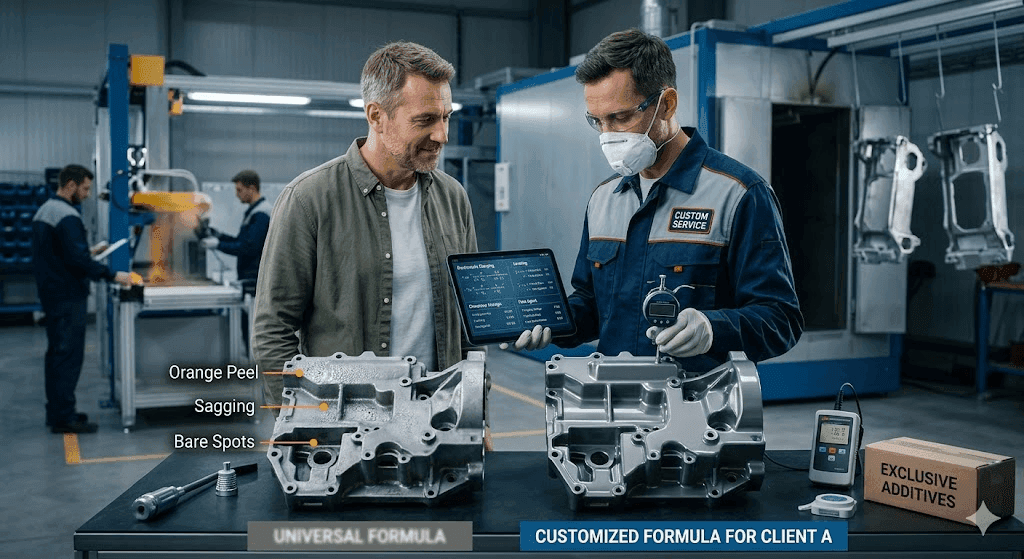
A custom powder coating request is more than a RAL or Pantone number. The supplier needs the part, substrate, pretreatment, appearance reference, service environment, application line, cure limits and acceptance tests. The buyer then needs a controlled path from laboratory sample to production approval. This guide turns a visual request into a specification that a powder coating manufacturer and purchaser can both evaluate.
Define the application before asking for a formula
Start with the coated part and its service conditions. Identify the metal or other approved substrate, geometry, fabrication residues, pretreatment, indoor or outdoor exposure, chemicals, heat, handling and expected appearance. State whether the request is a new development, a match to an existing powder, or an alternative to a named reference. The China powder coating manufacturer page explains DAMEI's sourcing workflow, and the powder coating fundamentals guide helps separate powder-material supply from job-coating service. A chemistry name alone does not establish suitability.
Choose an authoritative appearance reference
A catalog code is a communication starting point, not always the final production standard. Send the current RAL, Pantone or other specified code together with a physical panel or representative part when appearance is critical. Record the reference owner, surface, date and condition. Metallic, textured, matte and translucent finishes can change with application settings, film build, substrate and viewing geometry. Use the RAL powder coating color catalog to shortlist a direction, then agree which physical or measured reference governs acceptance.
Specify color measurement and tolerance
If color will be judged instrumentally, define the instrument geometry, illuminant, observer, color space, difference formula, measurement locations and acceptable tolerance. ASTM D2244 states that purchaser and seller should agree on the permissible tolerance and calculation procedure. It also warns that results from different color-difference systems are not interchangeable. Visual review remains important when metamerism, texture or effect pigments are involved. The powder coating color-difference guide explains how to document these choices without inventing a universal Delta E limit.
Define gloss, texture and special-effect controls
State the target gloss and measurement method rather than relying only on words such as matte or satin. ASTM D523 measures specular gloss at defined geometries, but texture, haze and distinctness of image can influence visual appearance beyond one gloss reading. For metallic or effect finishes, specify viewing conditions, application method and whether a bonded or other stabilized system is required. The gloss measurement guide provides a buyer checklist. Written descriptions, measured values and an approved physical panel should support one another.
Record substrate and pretreatment
The same powder can produce different adhesion, appearance and exposure results on different substrates or pretreatments. Define alloy or steel type where relevant, surface condition, cleaning and conversion process, rinsing, drying and any primer or multilayer system. Do not use a successful panel on one substrate as automatic proof for another. Review the pretreatment guide and identify the exact production process that the sample must represent.
Match the formulation to the coating line
Provide gun type, charging mode, booth and reclaim practice, target film build, line speed, oven type, part-metal mass and available metal-temperature window. The supplier's laboratory schedule must not be copied to production without verifying actual part metal temperature. Use the cure schedule guide to define a recorded profile and the film-thickness guide to select an appropriate measurement plan. If reclaim will be used, qualify the intended virgin-to-reclaim practice during the trial.
Select tests from the real requirement
ASTM D3451 provides a guide to procedures for coating powders and cured powder coatings, but it requires case-specific selection and purchaser-seller agreement. Choose only tests relevant to the substrate, exposure, product and failure risk. Appearance, color, gloss, film thickness and cure verification are common controls; adhesion, impact, flexibility, corrosion, humidity, chemical resistance or weathering may be added when the specification requires them. Each item needs its exact method, specimen preparation, conditioning, units, duration, evaluation and acceptance criterion.
Approve the laboratory panel without overextending it
The first panel confirms that the proposed formulation can produce an agreed result under recorded laboratory conditions. Mark the powder code, batch, substrate, pretreatment, film thickness, cure profile, application settings and evaluation date. Review it under the agreed lighting and measurement conditions. Approval should state what the panel represents: it may approve color and appearance for the next trial without yet approving corrosion performance or full production. Keep an identified master and working references so repeated handling does not degrade the only standard.
Run a representative production-line trial
TIGER Coatings recommends an acceptance trial on the actual application equipment because equipment, application variables and recycling can affect color and effect. Coat representative parts with the intended pretreatment, grounding, film build, reclaim practice and metal-temperature profile. Inspect difficult geometries and visible assemblies, not only flat coupons. Record the powder batch, settings, results and deviations. If the production trial differs from the laboratory panel, investigate the process and agree on the correct production reference before releasing routine orders.
Create a written approval and change-control record
The signed record should identify the approved formula or product code, revision, physical reference, test methods and limits, trial conditions, packaging, batch identification, required documents and authorized approvers. State which changes require notification or requalification, such as a formula revision, raw-material substitution, manufacturing-site change, new substrate, changed pretreatment or materially different coating line. This prevents an old approval from being applied to a different system without review.
Prepare repeat orders and receiving checks
Reference the approved specification and panel on the purchase order. At receipt, verify product code, batch, quantity, packaging condition and required documents. Store the powder under the current product guidance and apply first-off checks before combining it with existing stock or reclaim. When a repeat order will coat adjacent parts or continue a visible project, confirm the batch strategy and appearance match before full production. The storage and shelf-life guide explains why product-specific storage records matter.
Send a complete custom-coating request
For a DAMEI review, send the application, substrate, pretreatment, reference code and physical sample, color/gloss/texture controls, service exposure, coating-line and cure data, required tests, first-order and annual demand, packaging and destination. Use the contact form to request a technical review. DAMEI can propose a starting coating family and sample plan; the purchaser should release production only after the agreed evidence and representative trial are accepted.
References
- ASTM D3451-24: Standard Guide for Testing Coating Powders and Powder Coatings
- ASTM D2244-22: Calculation of color tolerances and color differences
- ASTM D523-25: Specular gloss
- TIGER Coatings: Batch-to-batch consistency and acceptance trials
- ISO 8130-12:2019: Determination of coating-powder compatibility