
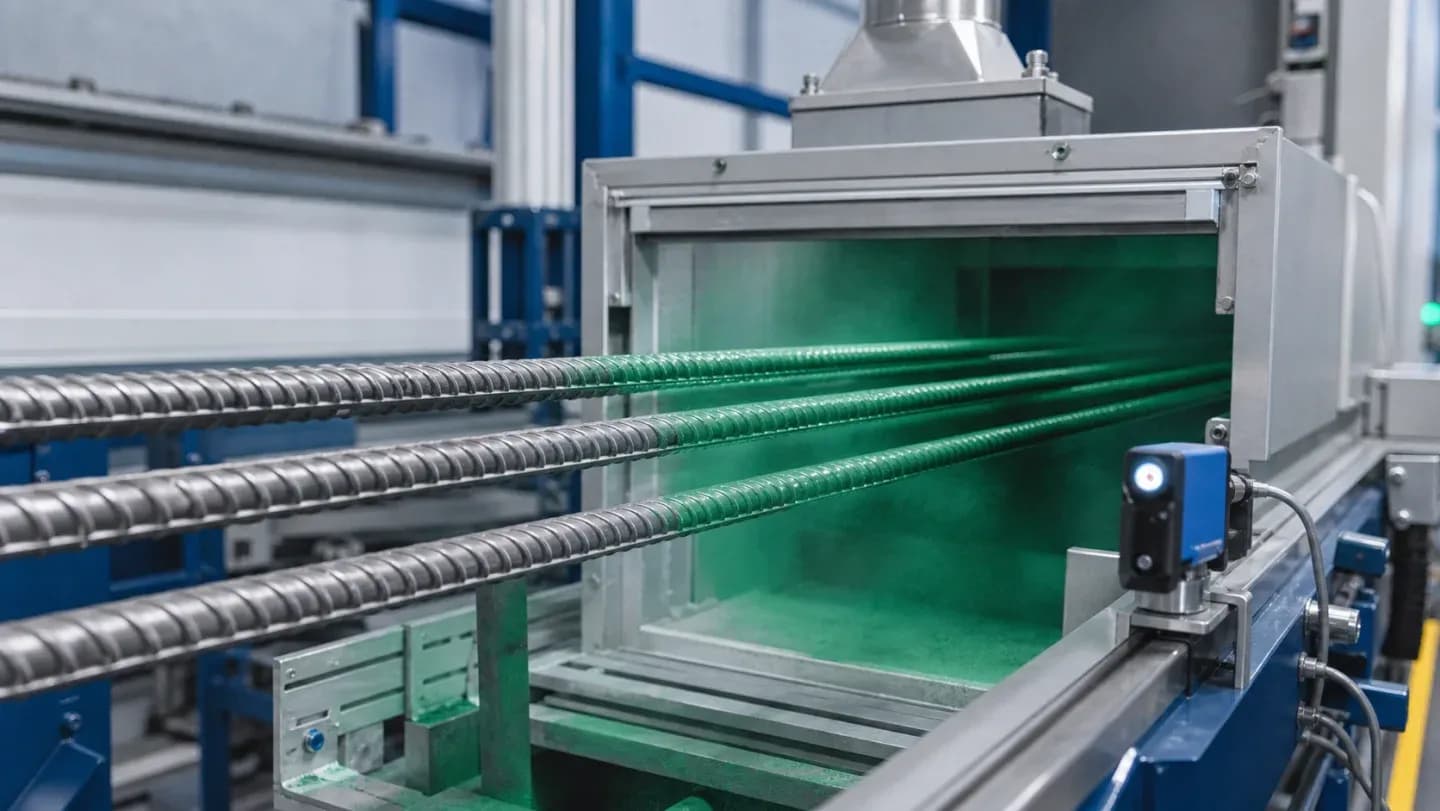
Fusion-bonded epoxy (FBE) powder coating is used as a barrier system on steel reinforcing bars where a project specification calls for epoxy-coated reinforcement. Good performance does not come from green color, a nominal thickness or an automated line alone. It depends on the selected standard, steel condition, fabrication sequence, powder qualification, surface preparation, application, cure, inspection, repair and handling as one controlled system.
This guide is for rebar coaters, infrastructure buyers, engineers and powder purchasers. DAMEI supplies powder-coating material; the project designer, bar fabricator, coating applicator and testing authority must approve the finished reinforcing steel under the governing contract.
Choose the governing route before choosing powder
ASTM A775/A775M covers deformed and plain reinforcing bars with a protective epoxy coating applied by electrostatic spray. ASTM A934/A934M covers bars that are prefabricated before surface preparation and then receive FBE; its scope states that coated prefabricated bars are not intended to be bent or rebent, and points users who require field bending toward A775/A775M. ASTM D3963/D3963M addresses fabrication and jobsite handling of epoxy-coated reinforcing bars.
ISO 14654:1999 covers FBE-coated post-fabricated and prefabricated bar, wire and welded fabric and distinguishes flexible Type A from nonflexible Type B coating. ISO currently lists that edition as published but under revision; the 2026 draft is not yet a replacement International Standard. Record the standard, edition, units and project amendments in the purchase order.
Do not combine acceptance numbers from A775, A934, ISO 14654, an AASHTO/DOT requirement and a supplier data sheet as if they were interchangeable.
Define the fabrication sequence and damage risk
The decision to coat straight bar before fabrication or to fabricate before coating changes the required flexibility, damage exposure and repair plan. Bending a coated bar can strain the film at ribs and bend radii. Coating a prefabricated shape can reduce later bending damage but may make presentation, spray access and inspection more complex.
Document bar grade and size, deformation pattern, cut ends, bends, welds if permitted, couplers, lifting points and final geometry. Identify who owns damage at each handoff. Where the project allows repair, specify approved patch material, preparation, maximum damage rules and inspection after repair. Never use the phrase “lifetime protection” as a substitute for these controls.
Qualify the exact FBE powder against the project standard
FBE rebar powders are fast-reacting thermoset epoxy systems designed to melt, flow, gel and cure on heated steel. Product data from suppliers such as AkzoNobel and IFS shows that commercial grades are formulated around specific ASTM, AASHTO or agency requirements. That does not mean every FBE powder meets every rebar specification.
Request the exact technical data sheet, safety data sheet, powder batch identity, storage limits and qualification report. Map each required property to its test clause, specimen and acceptance value. Check flexibility/bend performance, adhesion, coating thickness, holidays, cure or thermal characteristics, cathodic disbondment or chloride permeability only where required by the governing specification. A test result from pipe FBE, valve powder or a different rebar grade is not automatically applicable.
Prepare steel as a controlled surface, not a visual step
Mill scale, rust, oil, salts, dust and embedded contamination can compromise the barrier. The coating line should control incoming steel, abrasive cleanliness, surface profile, dust removal and time from blasting to coating. A bright appearance alone does not prove the specified cleanliness or profile.
Define the referenced preparation method, abrasive type and condition, profile-measurement method, environmental limits and rejection criteria. Control recycled abrasive and prevent cross-contamination. After blasting, protect steel from moisture, fingerprints and flash rust. The powder-coating pretreatment guide provides a broader framework for documenting substrate preparation; the rebar standard remains the authority for this application.
Match preheat, application and cure to the product data sheet
In the common process, prepared steel is heated, powder is electrostatically applied and the hot substrate drives melt, flow and reaction. Induction or another heating method can be used when the installed line can deliver the approved metal-temperature window. Oven or heater settings are not proof of bar temperature. Diameter, line speed, starting temperature and equipment loading all change the thermal history.
Measure representative bar-metal temperature and confirm the process window for the exact powder. Control gun layout, grounding, powder cloud, reclaim policy and booth contamination. Rib valleys, ends, supports and contact points need deliberate inspection; “360-degree spray” does not prove zero holidays. Use the cure-schedule guide to structure thermal evidence without inventing one universal temperature.
Control film thickness and coating continuity
The applicable standard or project specification should set thickness and continuity requirements. A supplier's typical range is not a universal contract value. Establish calibrated measurement equipment, bar locations, frequency and treatment of ribs or irregular geometry. Record both process data and final inspection.
Holiday detection is designed to find discontinuities under defined settings and procedures; it does not by itself prove adhesion, cure or service life. Confirm voltage, electrode contact, calibration/check method, line speed and response to detected defects. Use the film-thickness guide for method selection and traceability principles.
Verify cure without relying on color or gloss
A green, smooth film can still be undercured or thermally damaged. Use the cure checks required by the governing standard and the exact powder qualification plan. Retain the powder identity, bar size, line speed, measured thermal history, test result and acceptance decision.
If the line changes heater settings, bar diameter, powder lot or throughput, define when a new profile or verification is required. Do not “fix” a failed bend or adhesion result only by increasing temperature; investigate preparation, film build, thermal history, material condition and test execution.
Inspect, repair, cool and handle as one quality system
Cooling must occur only after the required reaction is achieved and in a manner compatible with the approved process. Quenching is not generic proof of cure control. End-of-line checks can include appearance, thickness, continuity, cure-related tests, bend performance and damage review as required.
After coating, use padded contact surfaces, non-damaging lifting and storage that avoids abrasion, dragging and prolonged unsupported deformation. Separate bundles and protect them during transport and fabrication. Inspect after each high-risk handoff. ASTM D3963/D3963M and project requirements should guide fabrication and field handling; the powder supplier cannot control site practice.
Build a traceable line-control plan
A defensible production record links each bundle to:
- steel source, grade, size and heat or lot identification;
- governing coating standard and project revision;
- abrasive and surface-preparation checks;
- powder product, lot, storage and reclaim status;
- bar-metal temperature and line settings;
- film-thickness locations and results;
- holiday-detection settings and dispositions;
- cure, adhesion or bend evidence required by the standard;
- repair material, location and reinspection;
- final release, bundle marking and transport controls.
The quality-control test guide helps distinguish qualification, process control and final acceptance evidence. CRSI's coating-plant standards also describe monitoring, testing, inspection, documentation and corrective-action expectations for certified facilities.
Compare rebar FBE suppliers on the same qualification plan
Do not compare only price per kilogram, gel time or a green panel. Provide both suppliers with the same standard, steel, line limits and acceptance matrix. Run a controlled trial across the relevant bar sizes and fabricated shapes. Confirm transfer, flow, cure window, continuity, flexibility and repair compatibility under the actual process.
DAMEI does not sell AkzoNobel Resicoat, IFS PureFlex or Sherwin-Williams Sher-Bar. Their public data is useful evidence that rebar FBE is a specification-driven category, not proof of equivalence. Use the supplier qualification checklist and require the alternative to pass the purchaser's own tests.
What to include in an FBE rebar RFQ
Provide the governing standard and edition, project authority, bar grade and sizes, straight or prefabricated route, expected line temperatures and speeds, surface-preparation capability, target film and holiday criteria, bend/flexibility requirements, repair procedure, test documentation, packaging, destination and approval quantity. Identify agency or plant-certification requirements separately from powder properties.
DAMEI can review the requested chemistry, line window and sample plan and provide available formulation documents. Final suitability is established only after the buyer approves production-representative coated steel. Contact DAMEI with the full project specification.
Frequently asked questions
Are ASTM A775 and ASTM A934 interchangeable?
No. They cover different fabrication/coating routes. The project designer must specify the applicable document and edition.
Does automated spraying prove complete coverage?
No. Geometry, grounding, gun arrangement, contact points and process stability still require controlled inspection and holiday detection.
Can FBE-coated rebar be bent after coating?
Only as permitted by the governing standard and project. A934-coated prefabricated bar is not intended to be bent or rebent; A775 should be reviewed where post-coating bending is required.
Does a passing salt or immersion test prove service life?
No. It supports performance under a defined method and specimen. Concrete design, damage, handling and exposure also affect the structure.
Primary references
- ASTM A775/A775M-22: epoxy-coated steel reinforcing bars
- ASTM A934/A934M-22: epoxy-coated prefabricated steel reinforcing bars
- ASTM D3963/D3963M-21: fabrication and jobsite handling
- ISO 14654:1999: epoxy-coated steel for concrete reinforcement
- ISO/DIS 14654 revision status
- CRSI coating-plant and fabrication standards
- IFS PureFlex FBE for rebar